Ikaria Island | GREECE
Ikaria, where food sustainability is a lesson
A journey to the island that lives to the rhythm of the earth and teaches the world another way to produce, share, and innovate.
Ikaria Island | GREECE
Ikaria, where food sustainability is a lesson
A journey to the island that lives to the rhythm of the earth and teaches the world another way to produce, share, and innovate.
What can a Greek island teach us about sustainable food systems and community resilience?
These concepts – along with conviviality and determination – are often associated with Ikaria, where food is a social glue and ecological knowledge, rooted in tradition, and intertwines with future environmental sustainability goals.
What can a Greek island teach us about sustainable food systems and community resilience?
These concepts – along with conviviality and determination – are often associated with Ikaria, where food is a social glue and ecological knowledge, rooted in tradition, intertwines with future environmental sustainability goals.
During an event hosted at Terra Madre 2024, I met Stavros Rantas, the founder of Slow Food on the island, and Lukás Gourtsoyannis, who manages the sailing logistics company, Aegean Cargo Sailing. He was the one who brought various local products transported on his boat to La Spezia, and then to Turin by land. Following the success of a well-known television program on longevity, the event captivated the senses with wines and cheeses, but above all ignited in me a new curiosity, fueled also by my long-standing connection with Greece. Interested in gastronomy, sustainability, and experiential tourism – even in a professional sense – the transition from idea to journey felt natural. Less than a year later, I was in Ikaria, in a delegation of two members of the Slow Food convivium of Glasgow.
During an event hosted at Terra Madre 2024, I met Stavros Rantas, the founder of Slow Food on the island, and Lukás Gourtsoyannis, who manages the sailing logistics company Aegean Cargo Sailing. He was the one who brought various local products transported on his boat to La Spezia, and then to Turin by land. Following the success of a well-known television program on longevity, the event captivated the senses with wines and cheeses, but above all ignited in me a new curiosity, fueled also by my long-standing connection with Greece. Interested in gastronomy, sustainability, and experiential tourism – even in a professional sense – the transition from idea to journey felt natural. Less than a year later, I was in Ikaria, in a delegation of two members of the Slow Food convivium of Glasgow.
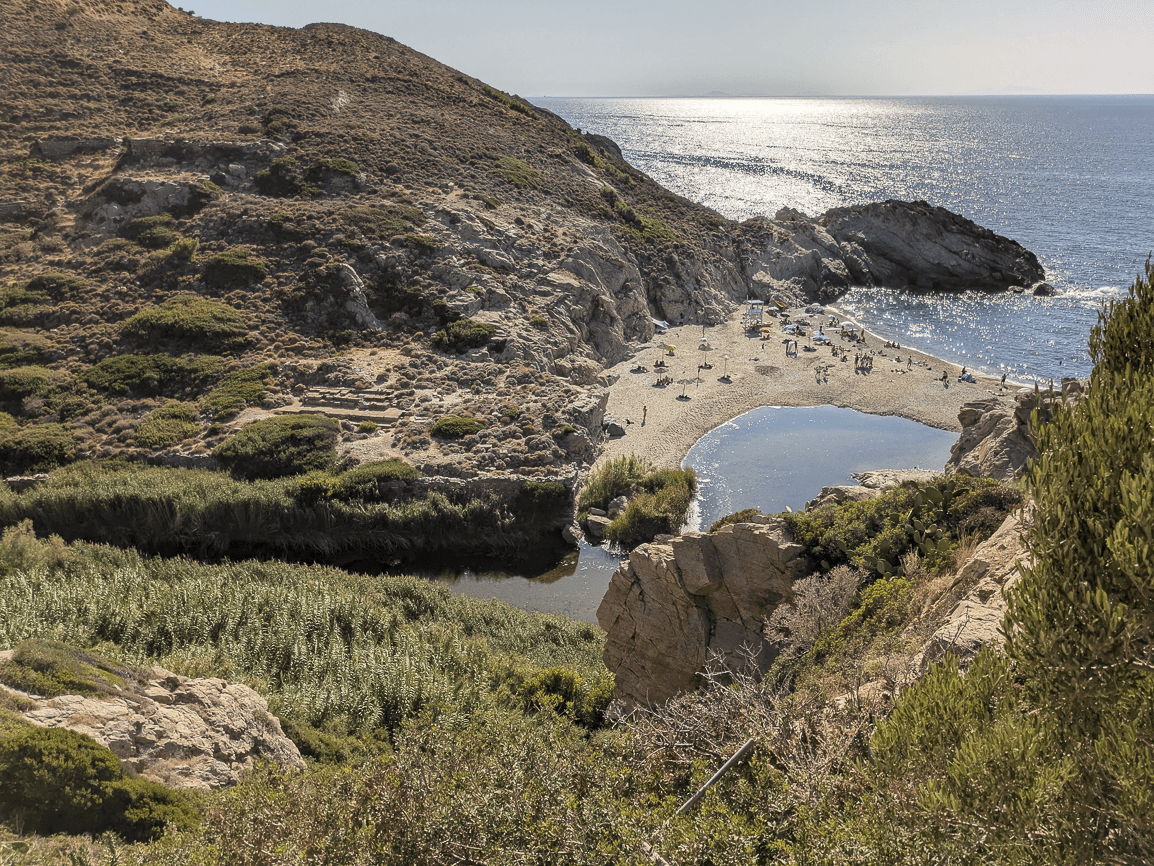
When I was still in Scotland, I contacted Stavros and then Anna Meli, the representative of Slow Food Ikaria, who helped me build an itinerary to better understand their work.
The meticulous organization of the trip was then overshadowed by the spontaneity of the island: upon waking up, sitting down for a coffee, a man gets out of his pickup truck with a bunch of red grapes and, offered them to us, proudly saying: “This is my product”.
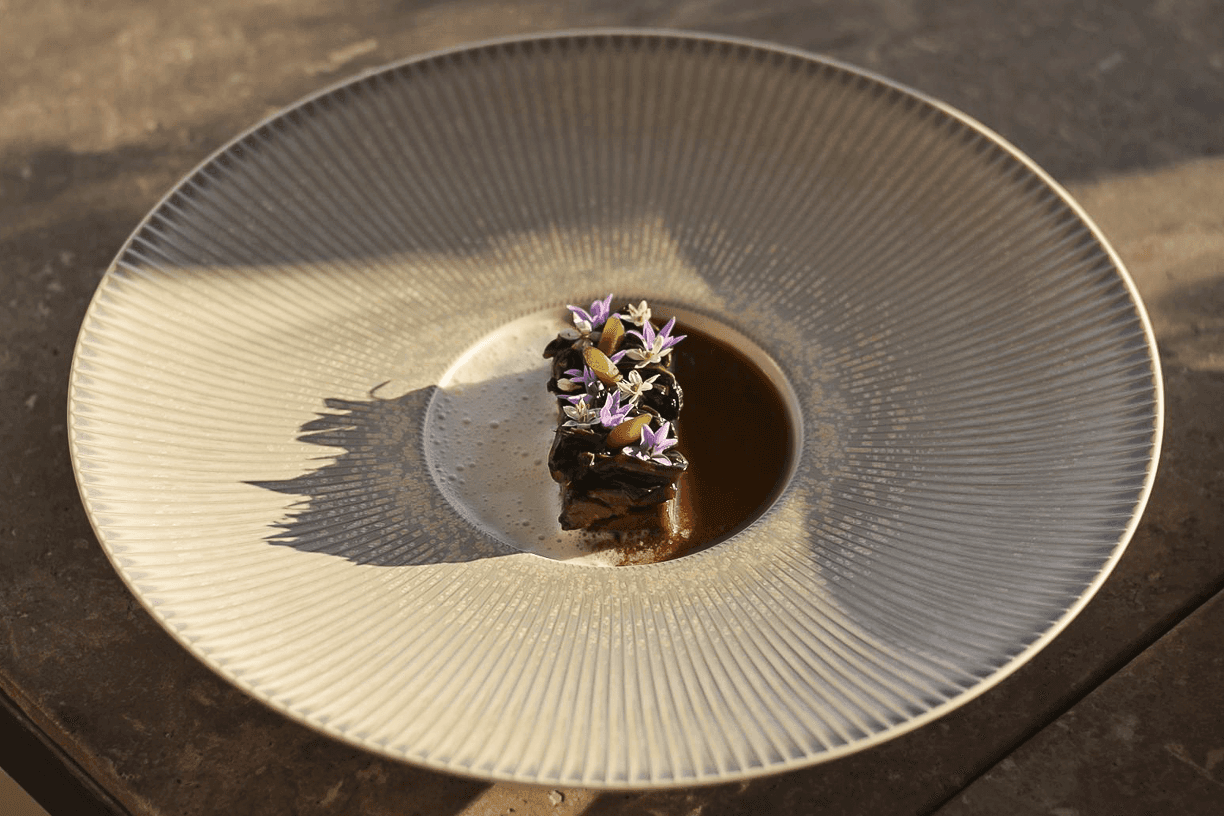
A simple gesture that opened the day before we moved west, where Anna welcomed us at her family restaurant, Artemis (also a ceramics workshop), overlooking Nas Bay. Opened in the early 1980s by her parents, it is named after the temple of Artemis, the protector of sailors. The terrace is a reconciling place, while the kitchen preserves tradition by reinterpreting it with awareness.
The meticulous organization of the trip was then overshadowed by the spontaneity of the island: upon waking up, sitting down for a coffee, a man gets out of his pickup truck with a bunch of red grapes and, offering them to us, proudly says: “This is my product”.
A simple gesture that opened the day before we moved west, where Anna welcomed us at the family restaurant, Artemis (also a ceramics workshop), overlooking Nas Bay. Opened in the early 1980s by her parents, it is named after the temple of Artemis, the protector of sailors. The terrace is a reconciling place, while the kitchen preserves tradition by reinterpreting it with awareness.
Artemis is part of a network of businesses that preserve biodiversity and local knowledge, transforming each dish into a collaborative act.
Anna introduced us to one of these realities: Arteis, a family-run agricultural company that produces olives, local grape varieties (Fokiano and Begleri), citrus fruits, stone fruits, chestnuts, wild herbs, cultivated herbs (fifty varieties!), and seasonal vegetables. The company is located in Agios Polykarpos, near the village of Raches. Following the ethics of the Petrinian eco-gastronomic movement, it is deeply committed to the conservation and use of local seed varieties, with in-situ conservation practices consistent with agroecological models. The network, introduced by Anna continues into wine production, a blend of ancient myths, microclimates, indigenous varieties, and wild yeasts.
Anna introduced us to one of these realities: Arteis, a family-run agricultural company that produces olives, local grape varieties (Fokiano and Begleri), citrus fruits, stone fruits, chestnuts, wild herbs, cultivated herbs (fifty varieties!), and seasonal vegetables. The company is located in Agios Polykarpos, near the village of Raches. Following the ethics of the Petrinian eco-gastronomic movement, it is deeply committed to the conservation and use of local seed varieties, with in-situ conservation practices consistent with agroecological models. The network introduced by Anna continues into wine production, a blend of ancient myths, microclimates, indigenous varieties, and wild yeasts.
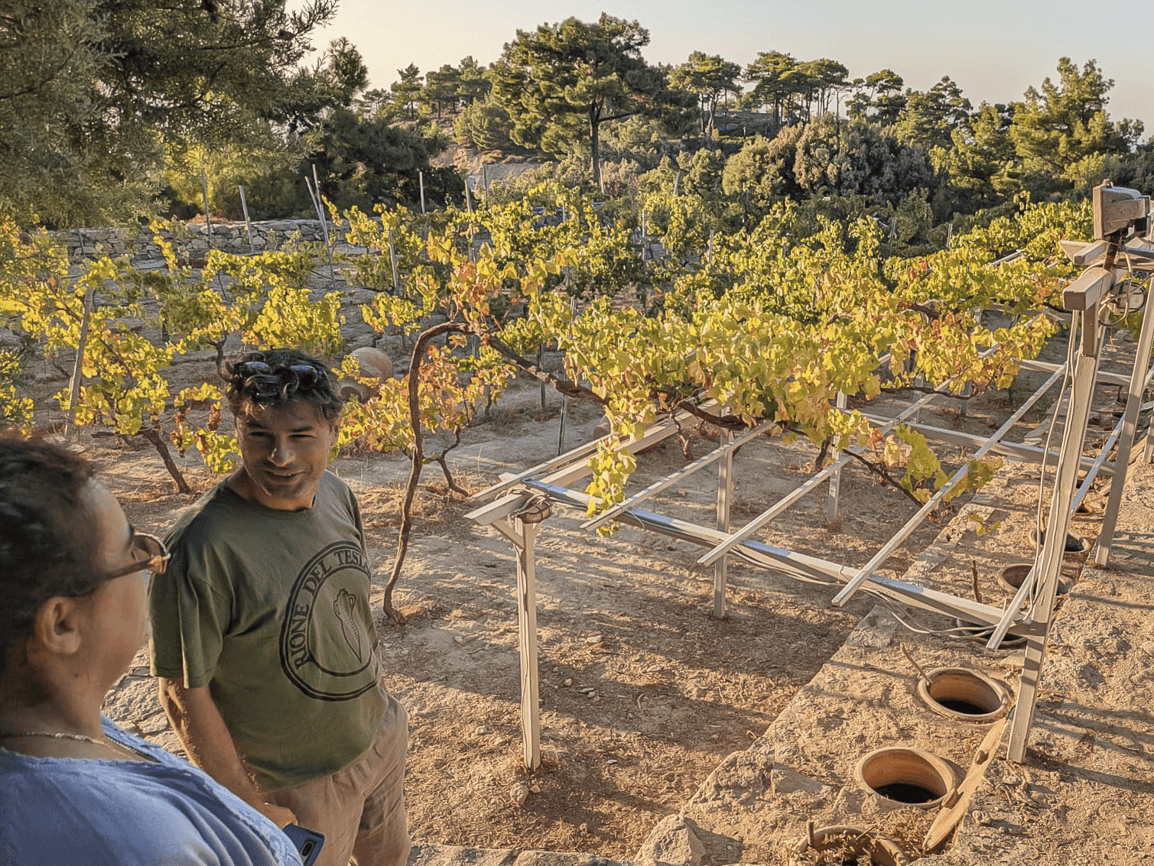
The first stop dedicated to wine was Afianes.
In the vineyard, we met Nikos and Maria, who cultivate on the western side of the island using organic methods and a spirit of experimentation grounded in centuries-old traditions. Maria guided us through rows exposed to the winds, then to the granite vat for pressing and to the underground amphorae for fermentation, the result of Nikos's historical research on local winemaking practices. The small tour concludes with a collection of objects related to viticulture, pastoralism, and the gastronomic uses of the island. She then told us that the decision not to use commercial yeasts but to promote those naturally present on the grapes is not a trend, but a conscious choice to stay consistent with the island's history.
Afianes' philosophy indeed picks up the interrupted thread after the phylloxera, when synthetic products were probably absent on Ikaria.
The first stop dedicated to wine was Afianes.
In the vineyard, we met Nikos and Maria, who cultivate on the western side of the island using organic methods and a spirit of experimentation grounded in centuries-old traditions. Maria guided us through rows exposed to the winds, then to the granite vat for pressing and to the underground amphorae for fermentation, the result of Nikos's historical research on local winemaking practices. The small tour concludes with a collection of objects related to viticulture, pastoralism, and the gastronomic uses of the island. She then told us that the decision not to use commercial yeasts but to promote those naturally present on the grapes is not a trend, but a conscious choice consistent with the island's history.
Afianes' philosophy indeed picks up the interrupted thread after the phylloxera, when synthetic products were probably absent on Ikaria.
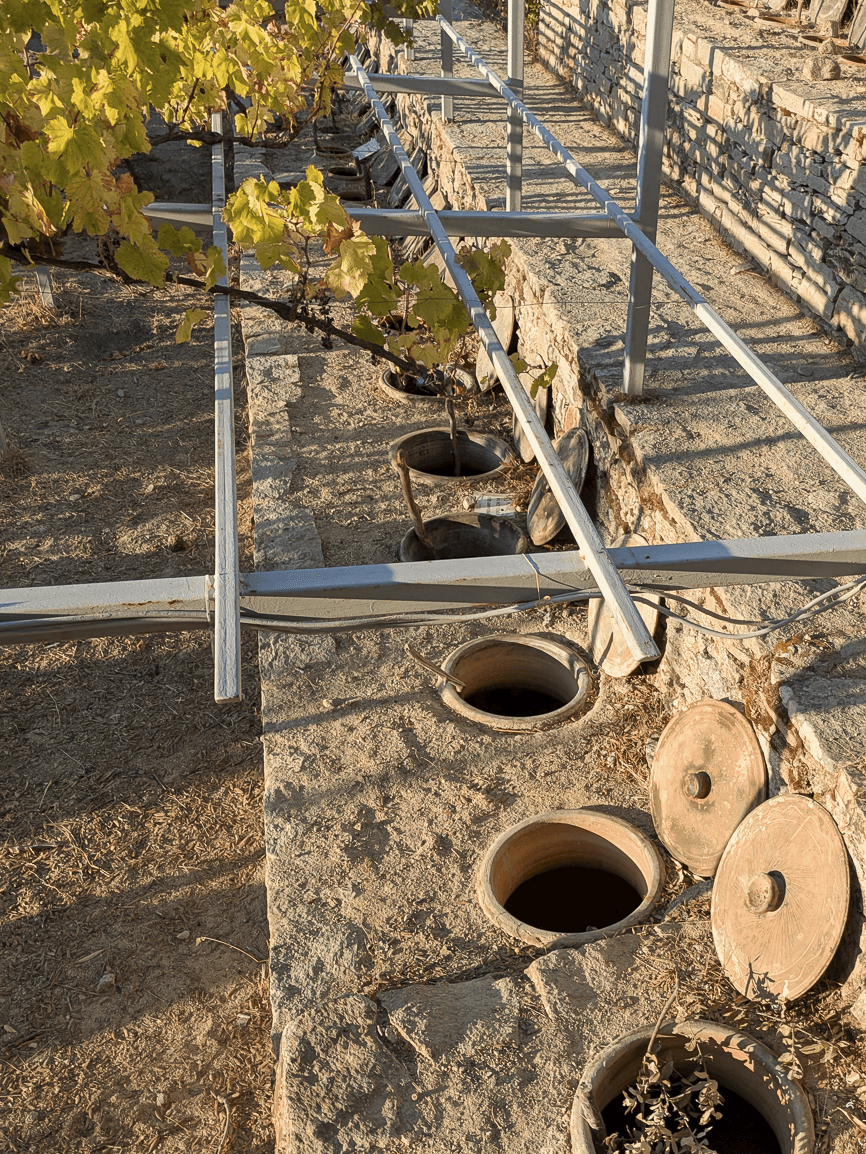
Here, the organic cultivation of the Fokiano and Begleri varieties takes place at different altitudes and microclimates, on a mountainous island that exceeds one thousand meters in height.
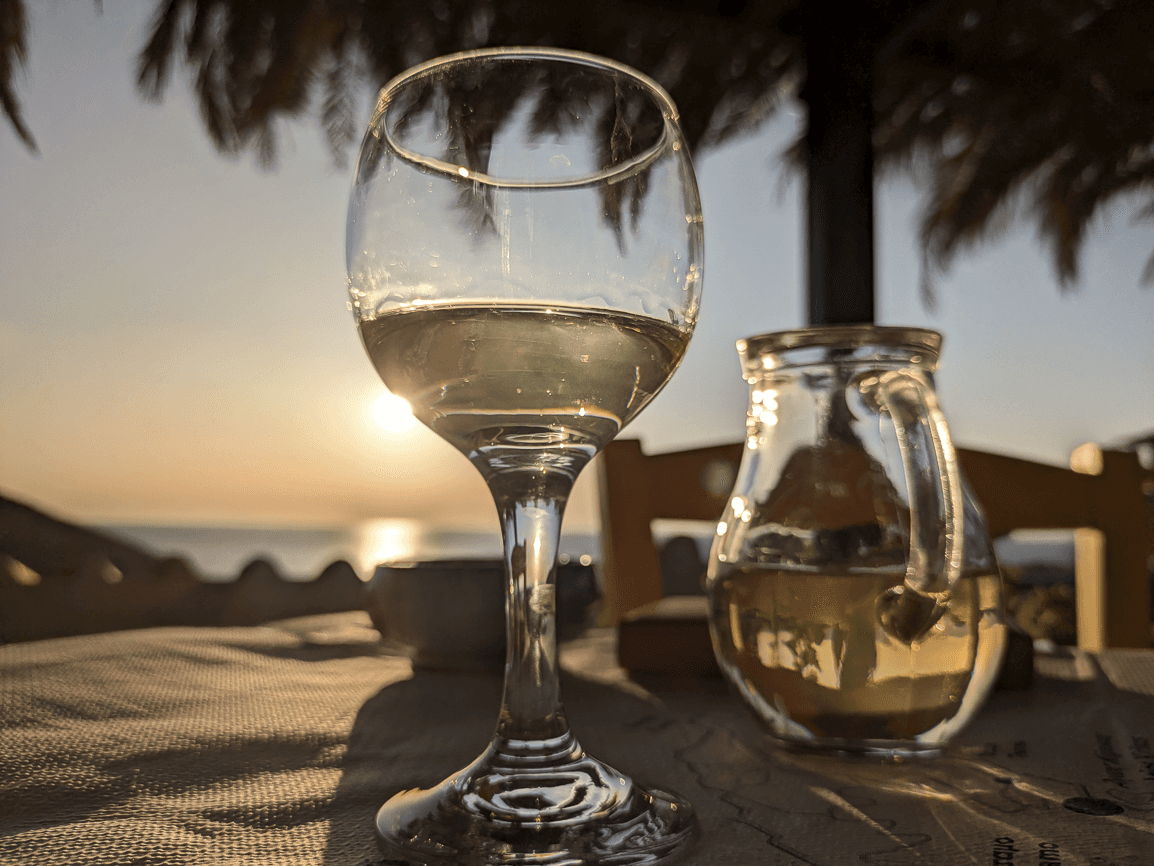
Sitting among the vines, at sunset over the Aegean, we listened to Nikos tell – calmly and lucidly – stories of wine, pirates, and Homeric myths.
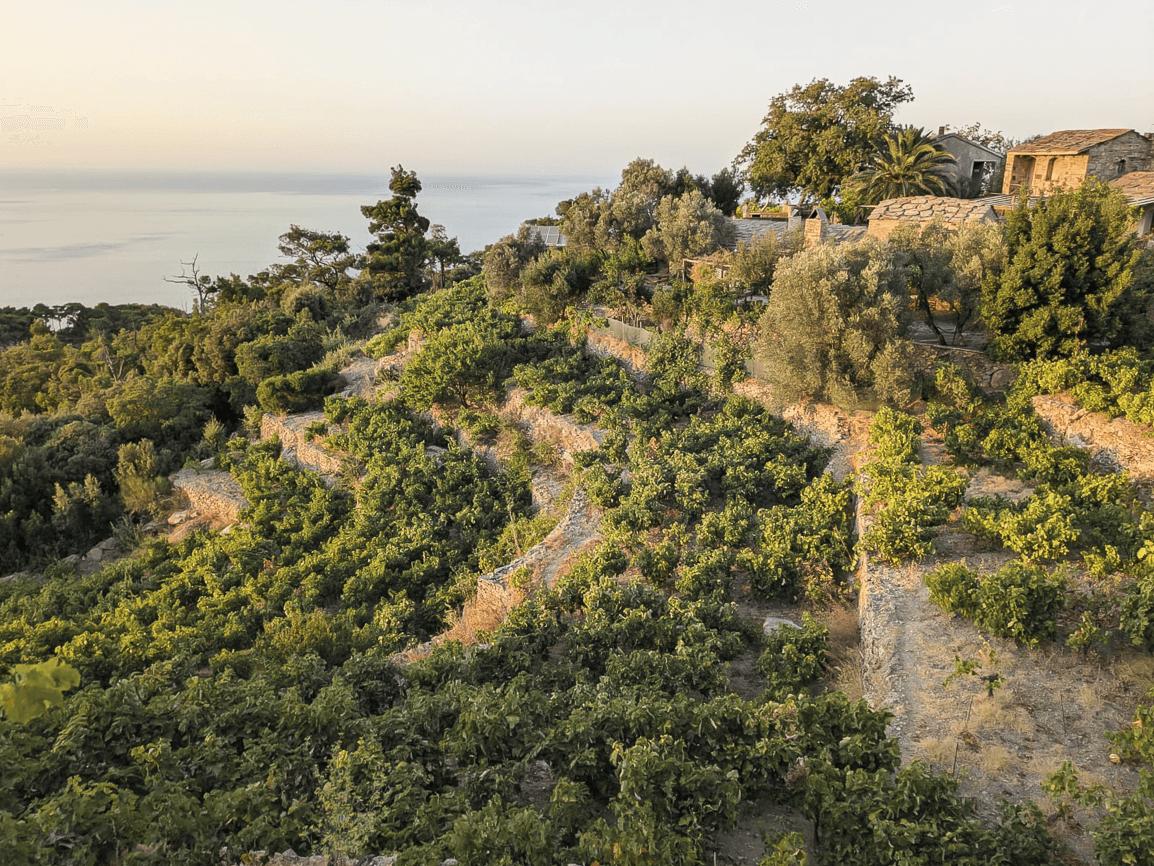
A few kilometers away was the second wine stop: the Karimalis winery, a farm and agritourism that combines contemporary practices with the conservation of indigenous varieties. Victoria shows us the vines grown on low terraces, pruned so that one branch protects the others from the wind. We met George while he was pressing the grapes, his daughter Iliana who was bottling the wine, and his wife Eleni, preparing the meal we would all share.
A few kilometers away is the second wine stop: the Karimalis winery, a farm and agritourism that combines contemporary practices with the conservation of indigenous varieties. Victoria shows us the vines grown on low terraces, pruned so that one branch protects the others from the wind. We met George while he was pressing the grapes, his daughter Iliana who was bottling the wine, and his wife Eleni, busy preparing the meal we would share.
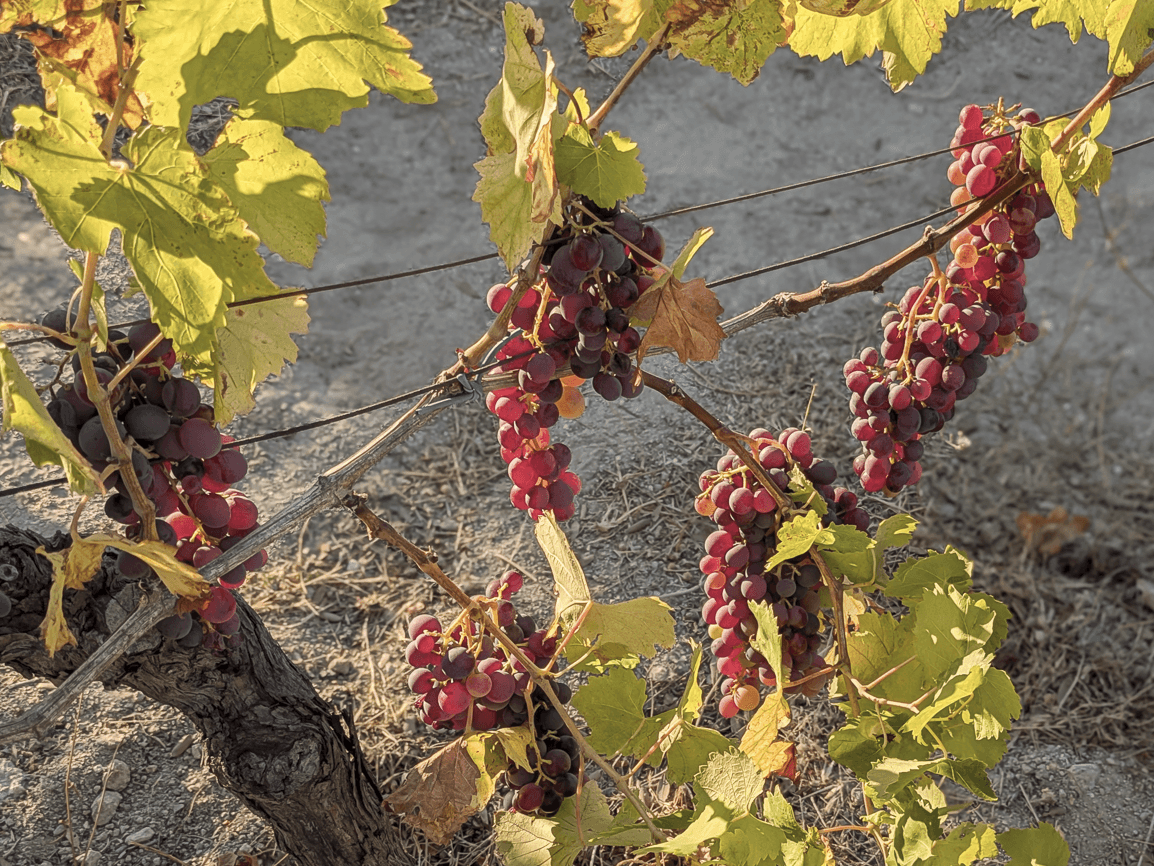
George's perseverance in transforming a steep, rocky land into a harmonious landscape interacts with Iliana's university skills, which leads the natural fermentation processes of reds (Fokiano, Koundouro, Reteno) and whites (Begleri, Assyrtiko).
George's perseverance in transforming a steep, rocky land into a harmonious landscape interacts with Iliana's university skills, who leads the natural fermentation processes of reds (Fokiano, Koundouro, Reteno) and whites (Begleri, Assyrtiko).
Nothing comes from chasing trends: the choice of the natural method precedes the trend by many years. It was only in 2019, when orders increased, that the company was able to consolidate this vision.
What struck us deeply is how every person we met embodied the essence of the island: a millennia-old tradition and openness to progress.
It’s not just about sustainable food production; it’s a way of life where caring for the land and community intertwine. Here, the solutions for innovation are not found by looking elsewhere, but rather by digging deeper into local knowledge to reinterpret it.
Ikaria challenges the dominant paradigms of innovation at all costs, which often overlook the knowledges passed down through generations.
This island reminds us that some things take time — a principle that has profound implications on how we approach transitions towards people-centered development models and the ecosystems in which they live.
What struck us deeply is how every person we met embodied the essence of the island: a millennia-old tradition and openness to progress.
It’s not just about sustainable food production; it’s a way of life where care for the land and community intertwine. Here, the solutions for innovation are not found by looking elsewhere, but by digging deeper into local knowledge to reinterpret it.
Ikaria challenges the dominant paradigms of innovation at all costs, which often overlook the knowledges passed down through generations.
This island reminds us that some things take time — a principle that has profound implications on how we approach transitions towards people-centered development models and the ecosystems in which they live.