

In the world of fine cheeses, Great Britain can be proud to produce one of the most famous, acclaimed, and beloved cheeses in the world: the king of blue cheeses, Stilton. This quintessential English cheese has a history as rich as its flavor. It’s a must-have at the end of Christmas dinner, but it also features in many recipes.
Its illustrious history begins in the early 18th century in a rural area of Great Britain, the village of Stilton in Cambridgeshire.
There are some mysteries lost to time regarding exactly when and where it originated. It is commonly believed that the name most likely derives from the village where it became famous, rather than from the place where it was originally produced. In fact, today Blue Stilton PDO cannot legally be produced in the county of Cambridgeshire; its production is limited to the counties of Nottinghamshire, Leicestershire, and Derbyshire. Perhaps this is due to the iron- and mineral-rich soils of these counties, which supported a mining industry and produced high-quality pasture unique to dairy cows.
In 1723, Richard Bradley, in his *Country, Housewife, and Lady’s Director*, wrote a recipe for Stilton, but without providing many details on size or aging, mentioning only that it was a hard, cooked cheese. In his notes, he also writes: “Drink a glass of beer, eat a small piece of Stilton every day, and you’ll become ‘old bones’…” Daniel Defoe, during his travels through rural England, refers to Stilton as “famous for its cheese.” In fact, the production of a cream cheese around this priory is well documented. Richard Ford, who traveled throughout Europe, stated that Stilton was considered by Europeans to be on par with Roquefort, Gorgonzola, and Parmigiano Reggiano (this text can be found in the *Oxford Companion to Cheese*). It was the French who said that “the only problem with Stilton is that it isn’t French.”
Cooper Thornhill—owner of The Bell Inn in Stilton, a famous local inn where travelers used to stop to eat and stay during their journeys between London and northern England and Scotland —struck a business agreement in 1743 with a renowned cheesemaker from Wymondham in Leicestershire, a woman named Frances Pawlett. She supplied the cheese to Thornhill through a cooperative of farmers and persuaded other Leicestershire cheesemakers to produce Stilton cheese according to her recipe. As its reputation grew, Blue Stilton began to gain recognition in London as well, where it started appearing in local markets.
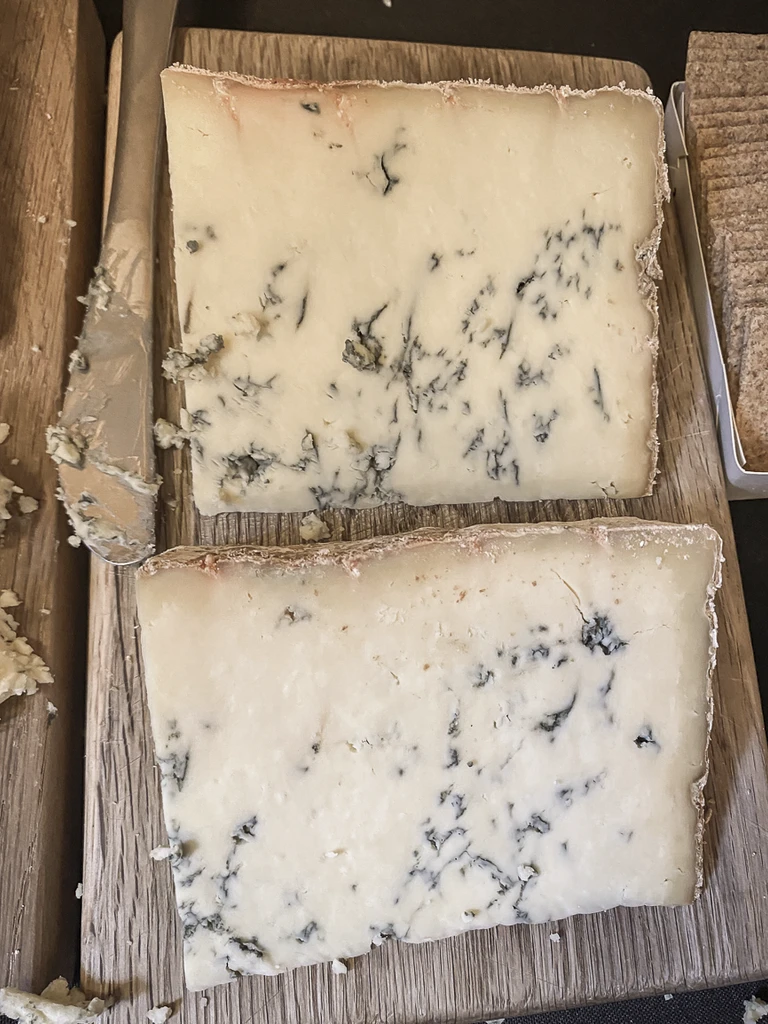
At the time, the blue-veined cheese produced in Leicestershire was nowhere near the Stilton we know today, as it could come in different sizes or shapes, and likely not all of it had a distinct blue color. Although there are actual documents proving who created Stilton, most production was done at home and passed down through family lines. Despite this, there are actual documents certifying who created Stilton.
During and after the Industrial Revolution, there was a shift from small-scale local production to more industrial, large-scale production, making the product available to a wider range of people year-round.
During the 18th and 19th centuries, goods were transported across the country via canals that ran from the countryside to London for trade or sale. During this slow and sometimes lengthy journey, Stilton—especially in the warmer months—was teeming with maggots (much like the famous Sardinian casu marzu), and it was customary to throw the maggots into the canal before eating it.
In 1936, the Stilton Cheese Producers’ Association was formed with the aim of lobbying for regulations that would protect the cheese’s quality and origin. This was also to defend against counterfeits, such as those from America—copies so well made that they bore the guild’s crests on their labels alongside the name “Stilton.”
While Stilton was originally made with raw milk, production switched to pasteurized milk in the late 1980s. It wasn’t until 1996 that it obtained Protected Designation of Origin status.
Blue cheeses are fascinating because they are the only aged cheeses with internal mold. This is in contrast to most soft cheeses and some hard cheeses, which are ripened by microbes that grow only on the outside of the cheese, such as Brie and Taleggio. Many modern consumers may be horrified by the appearance of this blue-green mold growing within the cheese, or may associate it with something harmful. This harmless blue-penicillin mold (a variant of Penicillium roqueforti or Penicillium glaucum) actually plays an important role in the ripening process and, consequently, in the cheese’s final texture, aroma, and flavor.
Stilton uses the Penicillium roqueforti mold. This mold is completely harmless in cheese production because the molds that grow on or in cheese do not produce the same harmful mycotoxins that can be produced on other foods. In cheese-making, the combination of acidity, salinity, moisture, density, temperature, and oxygen flow creates an environment completely unsuitable for toxin production. This is the very purpose of repeated fermentation: to preserve the milk by protecting it from pathogens and actual spoilage.
As the blue veins develop, they enhance the cheese’s flavor.
Penicillium roqueforti itself (and the enzymes it releases) aggressively breaks down the fat and proteins in the cheese to impart the texture, flavor, and aroma associated with blue-veined cheese: sharp, strong, pungent, and above all, savory or umami.
One of the most acclaimed and award-winning Stilton producers is Colston Bassett and District Dairy, founded in 1913 based on an idea by Dr. William Windley, who encouraged local farmers to raise the necessary capital to build a cooperative dairy. Windley also convinced local residents and his patients to purchase shares. After raising enough money from about forty people, they purchased half an acre of land and began producing milk.
Initially, there were 16 farmer-members supplying milk to the dairy, and the first cheese produced was Cheddar, due to wartime restrictions imposed by the infamous Milk Marketing Board. Stilton was considered too luxurious to be produced during the war years. In 1920, the dairy began producing Stilton, but production ceased again during World War II, and they returned to producing Cheddar-style cheese. Gradually, starting in the 1950s, Stilton production became stable again, as it remains today, with the cheese being produced year-round.
To make Stilton, cheesemakers add a powder made from pre-cultured mold spores to the curd. Once the curd has been cut and ground into small granules, it is placed in a cylindrical mold. The curd is not pressed, leaving an open structure to allow the blue mold to spread throughout the cheese. The blue mold added at the beginning remains inactive until the right conditions are met. First, the mold needs oxygen to grow, so after aging for more than 8 weeks, the wheel is pierced with needles. The air holes created by this “needling” process allow oxygen to enter the cheese, enabling the blue mold to develop properly.
Stilton is the king of the Christmas table in the United Kingdom, often enjoyed with a glass of Port.
It has become popular at this time of year because the highest-quality milk comes from summer pastures, ready to be enjoyed during the holidays. Stilton has a complex, mellow, rich, and smooth flavor—sweet and salty, nutty and earthy—with a slight hint of spice and tropical fruit aromas. However, what makes it even more unique is its crumbly, open texture that is at the same time creamy and buttery.
Here’s a recipe for serving a slice of 19th-century English flavor at a dinner party or special occasion.
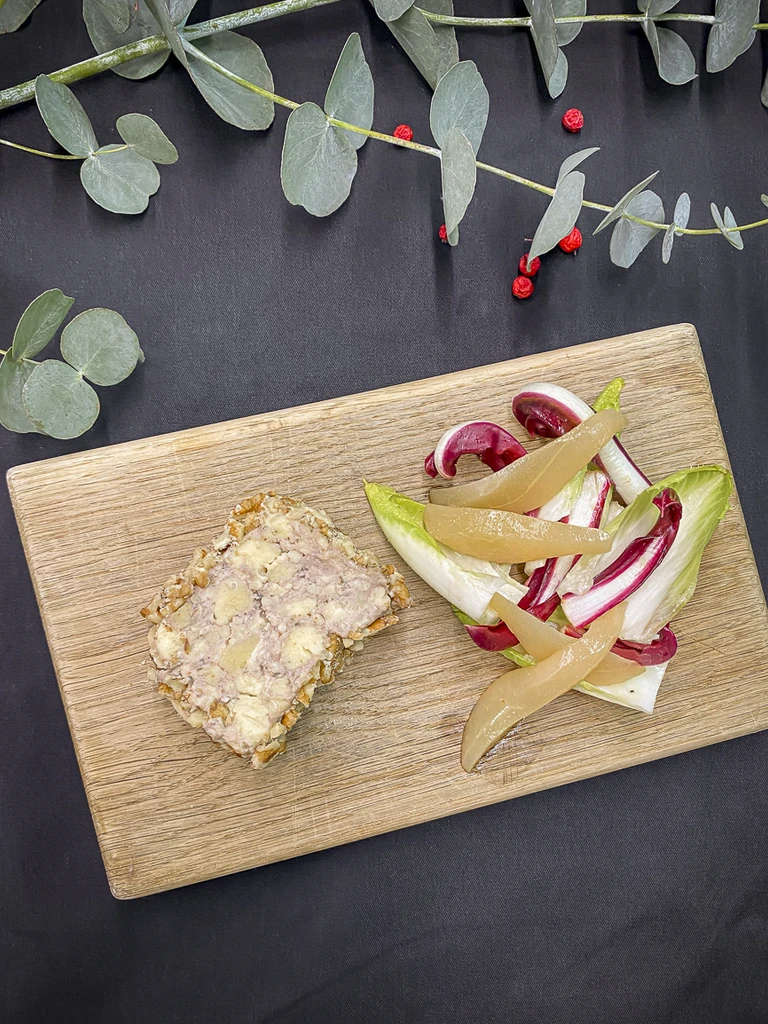
Stilton and Port Terrine with Pears and Walnuts:
This terrine needs one or two days in the refrigerator before it’s ready to enjoy, so start at least one day in advance.
Serves 10:
- 200 g granulated sugar
- 500 ml water
- 1 pear
- 500 g Stilton
- 60 ml of Port (for a complex, full-bodied flavor, choose a Tawny Port aged 10 years in oak; for a younger, sweeter flavor, choose a Ruby Port)
- 160 g halved walnuts
- 1 heaping teaspoon of demerara sugar
- Salt and freshly ground black pepper
Instructions
Place the granulated sugar and water in a small saucepan over medium heat.
Stir to dissolve the sugar.
Peel the pears, cut them in half, and remove the cores. Add them to the syrup in the small saucepan, reduce the heat, and cook for 10 minutes, or until they are slightly soft but still crisp. The cooking time depends on the type of pear.
Remove from the heat and let cool in the syrup.
Once cool, remove them with a slotted spoon and slice them thinly.
Next, crumble the Stilton into a bowl with your fingers, then add the Port. Mix with your hands until the Port is fully incorporated. Do not overwork the mixture.
Line a bowl or baking dish with plastic wrap. Add half of the cheese mixture and press down firmly. Fill any gaps in the cheese with slices of the pears cooked in the skillet.
Top with the remaining cheese mixture and press down again. Refrigerate overnight or for up to 2 days.
When ready to serve, place the walnuts and demerara sugar in a dry skillet over medium heat. Toast until the walnuts are well coated with caramelized sugar. Remove from the heat and crush the walnuts, breaking them into small pieces.
Unmold the terrine and sprinkle the walnuts over it, making sure they stick to the sides. Cut into slices and serve.