

As winter gives way to spring, the fields burst into lush, warm-green vegetation, dotted with colorful flowers. Rich in biodiversity, this bloom marks the beginning of what is perhaps the most beautiful season and brings with it the most extraordinary of goat cheeses.
After spending the cold months in the barn, the goats are free to roam. Their milk is abundant and rich in fat, protein, minerals, and volatile aromatic compounds. Left unpasteurized, it combines with countless microbes from the pasture, the udder, and the milking parlor. The goats choose what they like best from a buffet of fresh grass, flowers, and herbs. Many of these aromas are transferred to the milk, giving the cheese fresh, herbaceous, and floral notes unique to this time of spring growth.
Goats were among the first ruminants domesticated by humans
About 10,000 years ago, in the region now known as the Levant. The earliest documented goat cheese dates back 5,000 years. Traces of goat cheese were found in Tutankhamun’s tomb—perfect for enjoying for eternity.
These intelligent and hardy animals can graze in the most unlikely environments, from cold, steep mountains to hot, arid deserts. Unlike the more finicky heifers and sheep, goats—or “little goats”—will happily eat bitter and tough plant matter, even tree bark, and can survive without water for days. Goats were prized by small farms and families for their ability to live in confined spaces and to subsist on the family’s food scraps. Their extraordinary adaptability led to their rapid spread across the globe, transported by land and sea.
Goat’s milk is lower in lactose
And its fat forms smaller globules that are more easily broken down by the human digestive system, which is more delicate. Its health benefits also include a higher protein content than cow’s milk, more calcium, and less cholesterol, making it a perfect component of a balanced diet. Fresh goat’s milk produced by a skilled goat farmer has a fresh, mineral-rich aroma that is delicately sweet yet tangy and complex. It is the perfect raw material for producing soft cheeses, which age from a fresh, sweet, and milky flavor to a dense, spicy, and nutty complexity. However, this milk is versatile enough to produce every category of cheese, from goat raclette to goat blue and even goat gouda.
Today, France boasts the widest variety of what are known as “chèvres,” which come in a myriad of different forms. The love for goat cheese dates back more than a thousand years and seems to have only grown. However, the United Kingdom also has a history with goats.
Goats were once common in rural areas and were nicknamed “the poor man’s cow” because of their use by small families. In the 1700s, British agriculture changed drastically, and landowners began raising large herds of dairy cows in fenced-in pastures, depriving farmers of the ability to keep goats for personal use. It is only in recent decades that goat cheese production has begun to spread throughout the country, although it remains a relatively small sector of the British dairy industry. Goat’s milk and goat cheese are increasingly popular among British consumers, no doubt thanks to the social mobility of “vacationers” in the mid- to late 20th century who took their first trips to the Loire Valley and Provence.
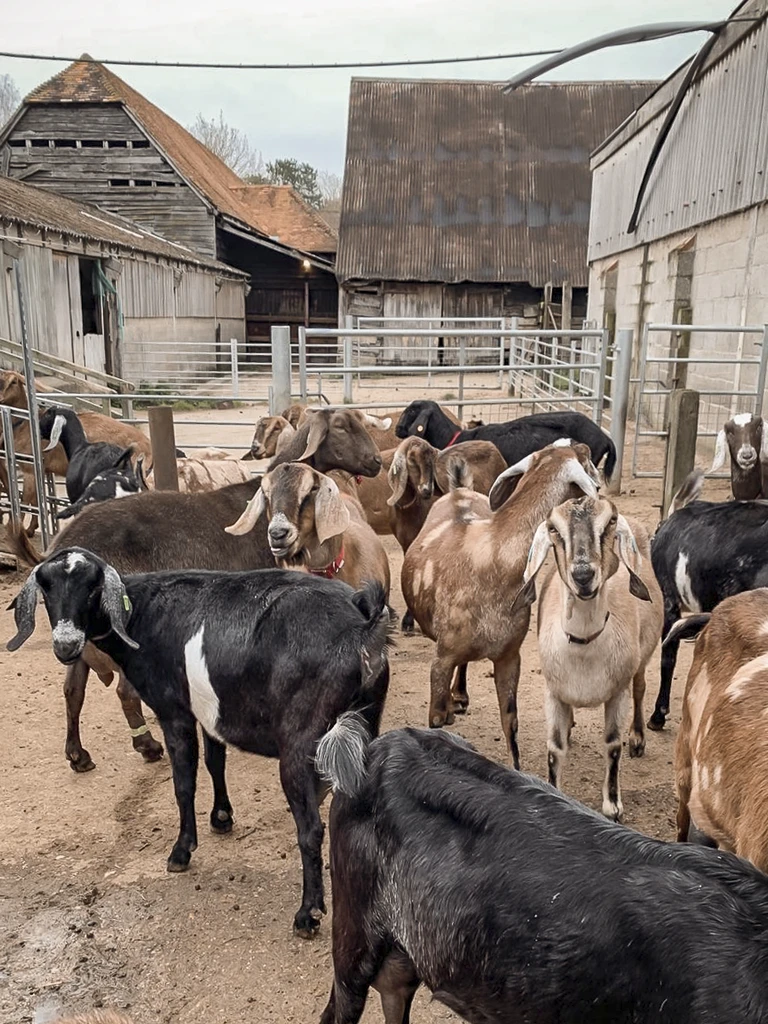
Unfortunately for lovers of traditional artisanal dairy products, the United Kingdom generally follows the modern European practice of keeping herds indoors year-round. The feed is identical from one season to the next, and lactation is staggered throughout the year. Outdoor grazing is virtually nonexistent.
Despite this widely accepted paradigm, some farmers have boldly switched to a more ethical and traditional method of open grazing. Among them, one of my favorites is the Norton and Yarrow dairy, based at the Earth Trust farm in Oxfordshire, which produces an award-winning goat cheese: Sinodun Hill and its ash-coated counterpart, Brightwell Ash.
Fraser Norton and Rachel Yarrow, though both from farming backgrounds, founded their goat cheese dairy in 2014. During a vacation in Sicily, they read an article in a British magazine left behind by another guest, which discussed goat cheese production and “living the good life.” This inspired them to take on a new challenge: leaving teaching and project management behind for a new adventure. They would move to the countryside and, with the help of the Earth Trust, focus on producing high-quality artisanal goat cheese, prioritizing animal welfare, sustainability, and the local community.
The result of this dream is a cheese that is now famous around the world
Sinodun Hill: a truncated pyramid-shaped cheese made with an ancient form of vegetable rennet—thistle rennet—using milk from their herd of Anglo-Nubian goats. The chosen breed is nicknamed “the Jersey cow of goats” for its rich, high-fat milk, ideal for producing soft cheeses. During the winter months, the herd is fed hay harvested from the area’s wild meadows, while between March and October the animals graze freely on fresh pastures, feeding on the local flora that abounds in this area.
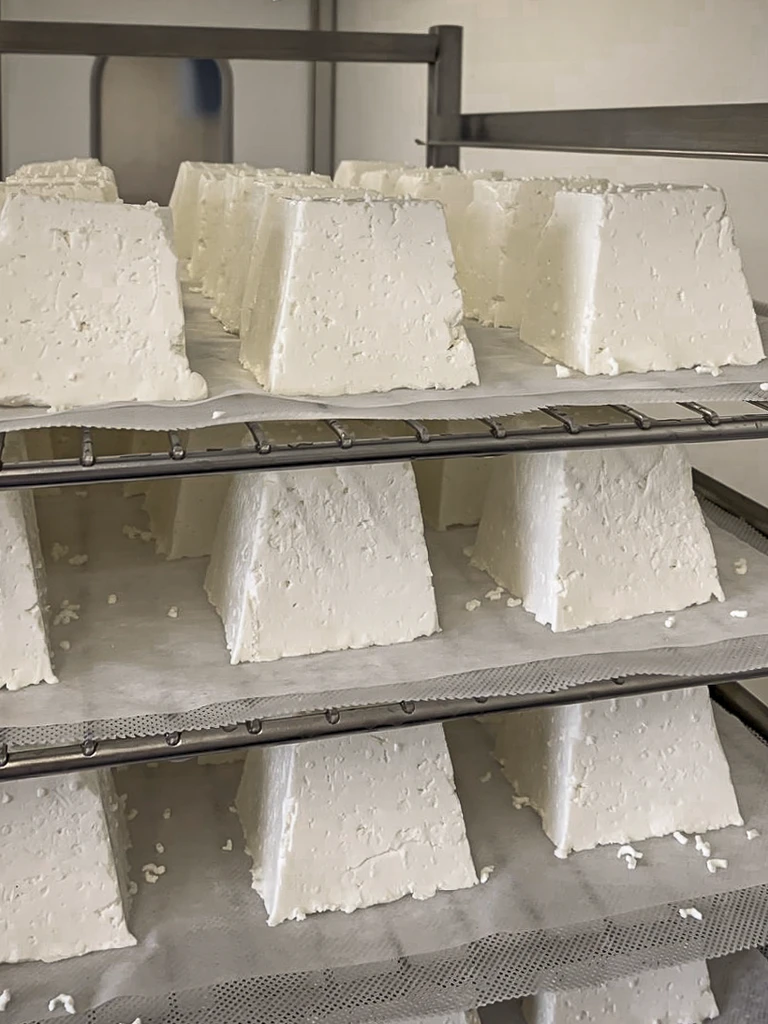
The initial fermentation takes place over a period of four days. The addition of starter cultures and thistle rennet to the milk is minimal, as the process relies primarily on microbes from the previous day’s whey to acidify and coagulate the milk over the course of a day or more. The delicate lactic curd is left to drain in molds for several days, and then the formed cheese is placed on racks to allow the beautiful surface mold to “bloom.”
Sinodun Hill cheese takes its name from a chalk hill in the Thames Valley that overlooks the cheese dairy. It has a strong flavor of yogurt, thyme, and citrus, and a creamy, mousse-like texture. The rind is the work of a special mold-like yeast, Geotrichum, which creates a rough, ivory-colored rind that gently breaks through the underlying cheese to reveal subtle aromas that complement the freshness of the cheese’s center.
Until a few decades ago, it was nearly impossible to serve a British cheese platter that began with a goat cheese. Thanks to the work of some great artisan cheesemakers like Fraser and Rachel, not only have the varieties and selection expanded, but the long-lost local tradition of British goat cheese production has also been revived with splendid results.